
Services / Botulinum Toxin
Botulinum Toxin for Jaw Tension & Facial Lines
Botulinum toxin, best known by the brand name Botox®, temporarily relaxes the muscles it is injected into. In a dental office it has two uses: easing overactive jaw muscles involved in clenching and grinding, and softening certain facial lines. Dr. Karbasi offers both.
How it works
A muscle contracts when a nerve releases a chemical signal. Botulinum toxin blocks that signal where it’s injected, so the muscle contracts less forcefully. The effect begins within a few days, builds over the first week or two, and wears off gradually over about three to four months as the nerve endings recover.
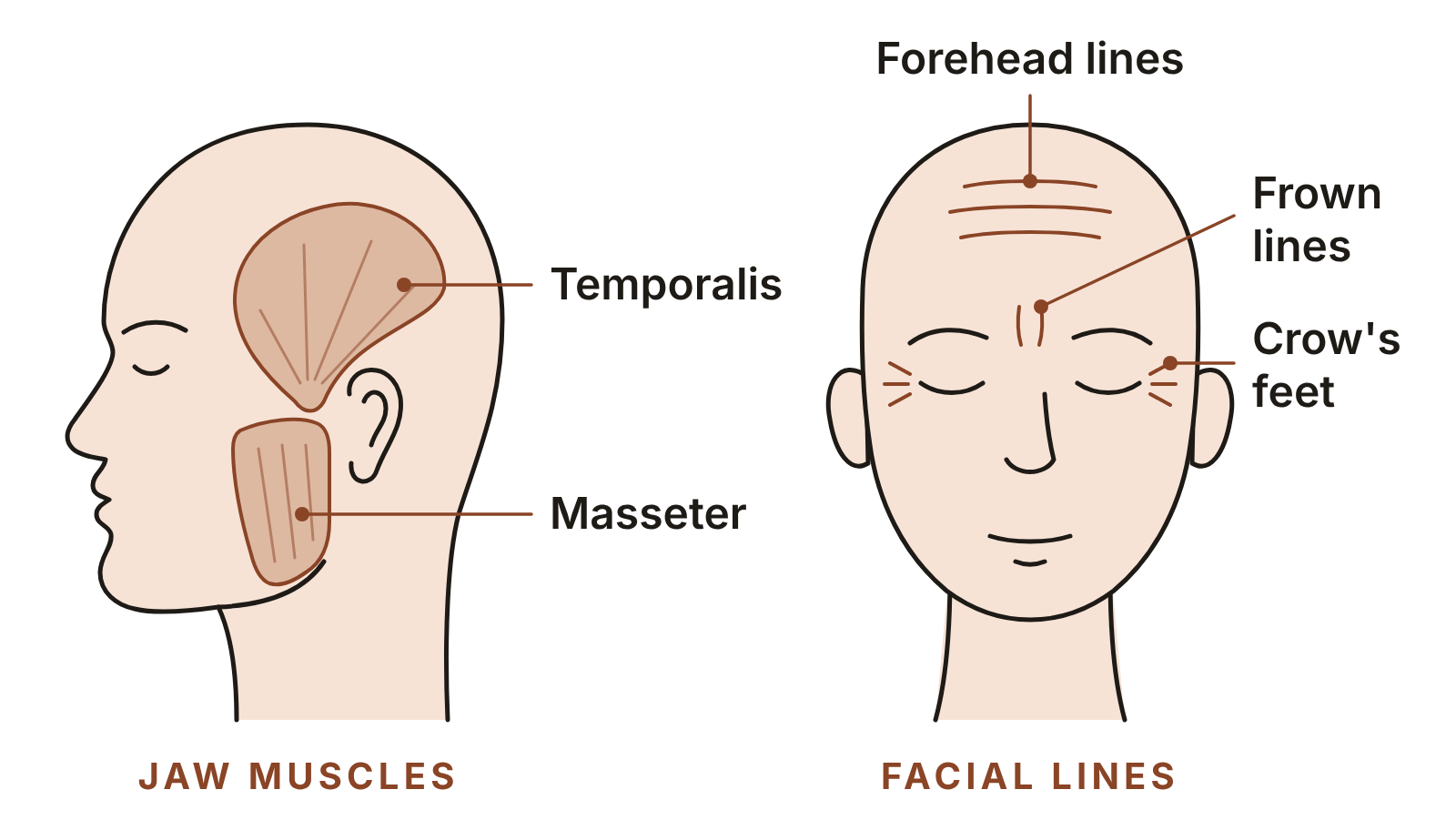
The two main jaw-closing muscles, and the three facial areas most often treated.
Clenching, grinding and jaw muscle pain
Bruxism is the habit of clenching or grinding the teeth, awake or asleep. Over time it can leave the jaw muscles sore and enlarged, and can wear or crack teeth. Small doses of botulinum toxin placed in the masseter (the main chewing muscle, at the angle of the jaw) and sometimes the temporalis (at the temple) reduce how hard those muscles can squeeze.
The studies so far are small, but they consistently find that patients report less pain and lower bite force afterward. Botulinum toxin does not stop the grinding itself: sleep studies show the number of episodes stays about the same, and it hasn’t been shown to prevent tooth wear. For that reason it is an addition to a night guard, not a replacement for one.
TMJ disorders
For temporomandibular joint disorders, often called TMJ or TMD, conservative care comes first: jaw exercises and stretching, awareness of clenching habits, a night guard, and time. Clinical guidelines do not recommend botulinum toxin as routine treatment for chronic TMD pain. We consider it for selected patients whose pain is clearly muscular and hasn’t responded to those measures.
Off-label use
Botulinum toxin is not FDA-approved for bruxism, TMD or jaw muscle pain. Using an approved medication for a purpose outside its labeling is legal and common in medicine and dentistry, and is called off-label use. We’ll discuss what that means for you before you decide.
Facial lines
Lines that form from repeated muscle movement, such as frowning, squinting and raising the eyebrows, soften when the muscle underneath relaxes. Botulinum toxin is FDA-approved for the temporary improvement of moderate to severe frown lines between the eyebrows, crow’s feet at the outer corners of the eyes, and horizontal forehead lines in adults. Dentists are trained in the anatomy of the face and give precise injections every day, which carries over naturally to this work.
Who may be a candidate
It may be a good fit for
- Adults with jaw muscle soreness or tightness linked to clenching, especially when a night guard alone hasn’t been enough
- Adults bothered by enlarged or tight jaw muscles from grinding
- Adults who want to soften frown lines, forehead lines or crow’s feet
- People in good general health who understand the result is temporary
It is not recommended if
- You are pregnant or breastfeeding
- You have a neuromuscular condition such as myasthenia gravis, ALS or Lambert-Eaton syndrome
- You’ve had an allergic reaction to any botulinum toxin product
- There is an infection where the injection would be given
Tell us about every medication and supplement you take. A few, including certain antibiotics, can interact with botulinum toxin.
What to expect
Consultation
We review your health history and medications, examine your jaw muscles, joints and bite, and talk about what you’d like to change.
Treatment
A few small injections with a very fine needle. It takes a matter of minutes, and most people describe a brief pinch.
Afterward
You can go back to your day. We’ll give you simple aftercare instructions for the first few hours.
Follow-up
We check in at about two weeks, once the effect has built up.
Repeat, if you choose
The effect wears off in about three to four months. You decide whether to continue.
Risks and side effects
Most side effects are mild and temporary: tenderness, small bruises or swelling where the injections were given, and headache. Depending on the area treated, there can be temporary drooping of an eyelid or eyebrow or, with jaw muscle injections, tiredness when chewing tough foods or a slightly uneven smile until the effect wears off.
All botulinum toxin products carry an FDA boxed warning that, rarely, the effect can spread beyond the injection site and cause serious symptoms such as difficulty swallowing or breathing. Seek medical care right away if you notice trouble swallowing, speaking or breathing, or unusual muscle weakness, in the hours to weeks after treatment.
Have a question about this?
Call us and we’ll talk it through, or bring it up at your next visit.
This page is general education, not personal dental advice. Dr. Karbasi will recommend what fits your situation at your visit.